Monday, 28 October 2013

Beautiful Bicheno

The sun is shining, the rain has gone, and Bicheno has been a wonderful 4 days of walking, cycling, talking to locals and just absorbing the beauty all around.  I thought that rather than my wittering on about our time here, the only true way to show you is with a series of Ray's excellent photos.

These beautiful yellow roses were blooming almost sight-unseen outside the Library.

Wallaby Salami anyone?  It's a bit hard to buy it after you see all the cute wallabies locally. 

White faced heron waiting for a fish.

Looking back at Peggy's Point.

Lots of bees working around these very ordinary "pig face" flowers.

Typical rock formations around the shoreline, with red algae which seems to occur all around Tasmania.

Ray found the native grasses very photogenic.

Panorama of Waub's Bay (named after a local aboriginal woman, Waubadebar whose bravery in rescuing two whalers earned her an enduring place in the local story).

Main Street, Bicheno, on Sunday afternoon!

Local church truly ecumenical, shared between Catholics, Anglican and Uniting - not all at the same time of course.

Bicheno Community Church.

Wonderful bakery; good coffee, scallop pies and jelly cakes!

One of the best Deli/Butcheries in Tasmania.  They sell wallaby salami though!

The Log Cabin; they sell everything you can think of and some you can't!

Pastini's Italian Cafe/Restaurant; also excellent coffee and pastries.

Controlled burn behind the town on a Sunday.  Everything we own now smells of smoke!

The Blowhole from a distance.  Wonderful rock formations.

The Blowhole in action; not much action there because of the calm seas, but it comes in with a satisfying noise anyway.


View over Bicheno from Whalers Lookout - with the view of the ocean from the other side of the lookout, the whales didn't have a chance!

The Gulch - the only sheltered harbour in Bicheno.  The outer rocks contain thousands of nesting terns, and a small rock to the right of the picture is a gathering place for fur seals.

Pelargoniums gone wild; they are all over the hillsides.

Foreshore walk to the Blowhole.

We're currently at Freycinet, thinking of doing the Wineglass Bay walk tomorrow.  It's windy but sunny, so all's right with the world.

Monday, 21 October 2013

Back in Range


Binalong Bay, Northern Bay of Fires

Superb Wrens sitting on our bike cover

Jeanneret Beach, Bay of Fires

Two happy pelicans at Musselroe Bay

Apologies for the length of time between blogs this time, but we have been out of range (yes I’m talking about you Telstra – where’s the NBN when you need it?) for a few days, which means no SMH, no phone coverage, and no internet! 

We stayed several nights at the Bay of Fires, named by Captain Furneaux who, from his ship, saw smoke from fires at Aborigines’ campsites, hence the name.  It’s a beautiful conservation area with several different campsites less than a kilometer from the road – Swimcart Beach, Jeanneret Beach and Cosy Corner being just a few, where 2 Superb wrens spent all afternoon attacking our windows.  The little brown female did most of the attacking, under the direction of the beautiful blue male.  

The first day, on Swimcart Beach, I was really tempted to don the togs and venture into the calm, emerald green water for a swim.  However, by the time I prevaricated about going in, the whole scene had changed with strong winds, and large waves.  We were warned by a local not to swim there as there are (fairly) frequent drownings.  The beach is very steep, and there is a huge drop off just where the waves roll onto the beach, with a big undertow.  You’d have to have absolutely perfect conditions there to venture into the water – and they don’t last long – though I think summer would offer kinder conditions.

After 2 nights at Swimcart and 1 at  Cosy Corner, we headed south to St Helens on Georges Bay for restocking.  St Helens has 2 IGAs(?) a pharmacy, several small bakery/cafes and sundry beachwear shops.  It has been our base in the east, as otherwise it’s just the occasional corner shop and not many of them.  Our other staple, water, is also available at St Helens, so we filled our tanks – both water and diesel, and set off north west along the A3, taking a side trip to Pyengana and the Holy Cow Café.  Pyengana cheese is rightly famous down here, and we bought enough (after a yummy tasting) to do us for a goodly while.  We also had lunch at the Holy Cow to sit a while by their open fire and watch the drizzle outside. 

In many ways this area reminds us of the Highlands of Scotland.  The constant mist, grey skies but emerald green hillsides dotted with black and white cows, the narrow winding roads and the cold.  We overnighted at the top of the Weldborough Pass in a huge paddock behind the 1886 Weldborough Pub, which markets itself as “the worst little pub in Australia”.  We really can’t vouch for that; having eaten breakfast at Binalong Bay, and lunch at The Holy Cow, we didn’t exactly feel like a night out at a pub!  I went for a walk in the afternoon and counted no less than 12 houses in the town; at least 2 of them For Sale!  Would you believe the only other caravan in the field belonged to 2 travellers from, where else, Raby Bay!

Only an hour or so from Weldborough lies a pretty little, well kept town called Derby.  Derby was the centre of the eastern tin mining industry in the late 1800s and has an excellent Tin Mine Centre.  We watched a video presentation of the history of the town, telling of the Chinese and other migrants who played a key role in the mining industry, and the ultimate destruction of most of the town, with resultant loss of life, in 1929 when the dam burst after massive rains.  It’s yet another interesting part of the history of Australia which is never taught in schools, but well worth reading.  (Sorry I can’t detail more of it here, but I’m sure Google would help).

After spending the morning in Derby we backtracked a few kilometres for the turnoff to Musselroe Bay in the far north east, taking an unsealed but generally good road from Gladstone to our current position alongside Musselroe Bay.  Once again we are the only people camped here – lucky it’s still early in the season.  There are quite a few houses here, mostly I think, holiday homes.  We’re surrounded by trees but the wind has abated quite a bit, the sun is shining and the sky is blue so all is right with the world.

After setting up, we went for a short walk along the narrow sandy beach beside the Bay, spotting some pelicans further down the shore.  Ray was disappointed when they took off almost as soon as we set foot on the beach, but far from disappearing over the horizon, they flew towards us and landed nearby, perhaps mistaking us for fishermen.  Then the 2 pelicans whose photos we’ve included, gave the most breathtaking display for around 15 minutes, flying in unison above and around us, seeming to enjoy every moment.  Lucky we have a digital camera, as Ray took hundreds of photos of them.  Trying to decide which one to put onto the blog was quite a task!

We hope to spend a few days here, perhaps sampling some of the other campsites, and Mt William National Park.  We’re only limited by the amount of water we carry; between 4-6 days if we’re careful.  The other essential is diesel – not only for powering the engine, but powering our wonderful diesel heater.  I was skeptical about its necessity when Ray was having it installed at great cost, but it really has been an excellent addition to our comfort.  One memorable night our tank dropped below one quarter and the heater safety switch cut out!  Merde!!!  We’ll never do that again.

Sally (and not forgetting Monsieur, who takes marvelous pictures)

PS  Our plans have changed once again, with inclement weather at Musselroe Bay.  We were heading for Tomahawk along the road to Bridport, but having to traverse about 20 kilometres of corrugated dirt road in the wet, we opted instead for heading back to St Helens and points south east.  We spent one delightful night at Stumpy's Bay campground, which was awash with Bennett's wallabies, all females with tiny babies aboard, where once again we bumped into locals (Wynnum); the only other people in the campground.  Tonight we're back at Swimcart Beach, and may head on south to St Mary's and Bicheno, or else just frowst here for a couple of days and try to wait out the coming rain.


Monday, 14 October 2013

Campbell Town postscript


Just couldn’t resist adding this to our Campbell Town blog.  I was walking around the back streets on our last morning and came across a lovely convict-built house with the following plaque outside:

“In the late 1800s Maria Burns lived here and whenever she looked next door she may have pondered on a dream that in the end had not come true. 

Maria had been raised in the Cork Foundling Home in Ireland and with many other girls from Dublin and Cork orphanages, she came to the district as a servant girl in 1836, aged 13.

Her first husband bought the land at what is now No. 6 Forster Street and promised her a dream home.  However it was not to be.  He was an alcoholic.  One night while heavily drunk at the Caledonian Hotel, he pledged the land to the local publican, and stayed at the bar until he had drunk the proceeds.

After his death in 1852, neither Maria nor her young family were heard to speak his name ever again, and he was buried in an unmarked grave in the Old Church Street cemetery.”

Friday, 11 October 2013

Stanley to Campell Town via the Tamar


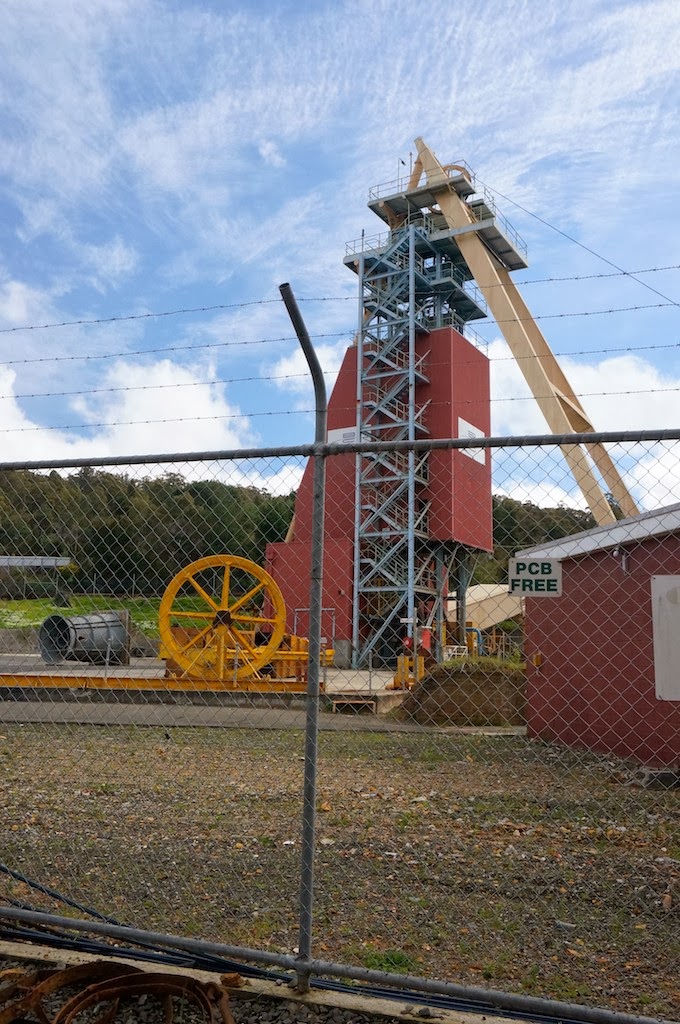
Beaconsfield mine head

View from our window, Elizabeth River, Campbell Town

Tree Sculptures, Blackburn Park

The convict-built Red Bridge, Campbelltown

Mutton birds anyone?

Having left Stanley reluctantly, we spent one night free camping at Sulphur Creek on our way east.  On our last visit we saw penguins, but this time it was just too cold to leave the van on the offchance of seeing any.  We were camped only a few metres from the rail line which runs along all the northern beaches - very picturesque, but also very noisy at night.  It's amazing how much in advance you can hear/feel the train coming along the line.  Luckily there's only one per night!

The next day we set off once again for parts unknown - vaguely in the direction of Bicheno, but ended up for 2 nights at Green's Beach, parked in a vast paddock with only one other caravan each night for company.  The camping area was excellent and at only $20 per night, quite a bargain, especially with its excellent washers and driers at only $2 a pop.  The van was turned upside down for used items and I very quickly emptied my collection of $1 coins!  According to the guidebook, Green's Beach is a relatively(!) undeveloped beachside hamlet 60km north west of Launceston and at the mouth of the Tamar River;  that just about sums it up - one small general store and a long, seaweed covered beach.

On the way to Green's, we passed through the town of Beaconsfield which most of you will remember as the place where on 25th April 2006, a small earthquake triggered an underground rock fall, trapping 17 people.  Fourteen escaped immediately following the collapse, one man was killed, and 2 men were found alive, but then spent 2 weeks awaiting rescue, trapped nearly a kilometre beneath the surface.  The Beanconsfield Mine and Heritage Centre is a fascinating place to spend an afternoon, and some of the story is told in the form of the ABC nightly coverage of the rescue, which most of us would remember vividly.  They have a small cage set up among rocks, into which you may crawl if you feel so inclined - just to get the feeling of what it must have been like to be trapped so far underground.   If you are not familiar with the story, Google it - it's one of the really good news stories in the history of mining.  

Thanks to Favourite Daughter our mail had at last arrived at Ray's cousin Dianne and Martin's place, so we called in to Epping Forest for a cuppa and to retrieve our long-awaited bank cards, without which we cannot continue to enjoy all those lovely treats!

Our progress to Epping Forest, however, was routed through Launceston where we spent the morning at their excellent hospital, investigating the reason for Ray's red and swollen left foot/toe.  The answer - Gout!  Having lived the life abstemious almost since leaving Brisbane (it is Ocsober after all), and Ray not fitting the generally-held description of a gout sufferer, he was more than a little miffed to discover this new affliction.  However, in record time he was diagnosed and had a prescription filled at the hospital pharmacy and we were on our way again.  Can you believe that we found a parking spot (2 actually) right outside the hospital - try that in any other city!  Thank you for asking, but he's now on the mend, can walk on the foot once again, and is in distinctly better spirits.

We were on our way again by lunchtime (partaking of a little light refreshment at Aroma's on the nearest corner to the hospital - well, Ray really did deserve a little treat this time!)  I noticed, on my forays in and out of Emergency while Ray was waiting to be seen, that all the local bike riders were massed at Aroma's, and that's always a good sign.  Right on - one of the best lunches we've had.

It was only a hop, skip and jump from Epping Forest to Campbell Town, where we are now parked for the second day by the Elizabeth River (both Campbell Town and Elizabeth River were named for Governor Macquarie's wife, Elizabeth Campbell).  Campbell Town was established in 1821 as one of four garrison towns and probation stations between Hobart and Launceston, and contains some lovely heritage buildings, and the 1838 convict-built Red Bridge, built with over a million red bricks.  There is also a Convict Brick Trail set into the pavement on both sides of the road running from the Bridge to the Hospital.  Each red brick has a convict's name, age, crime committed, punishment and name of their transport ship - salutary reading!  Campbell Town's annual June show, founded in 1838, is the oldest in Australia, having run every year since then - 175 years!

Blackburn Park, alongside the Red Bridge, contains three large carved macrocarpa trees, which have been turned into works of art by Eddie Freeman, and depict various features of the natural and human history of Campbell Town and the regions around.  The first shows a British soldier overseeing a convict working on Red Bridge, the second, rather incongruously, depicts Governor Macquarie and his wife Elizabeth, the bushranger Martin Cash(?), Dr William Valentine, (a noted local doctor who was involved from 1839 in all aspects of the town life), and Harold Gatty, who as a navigator for Wiley Post, took 8 days, 15 hours and 15 minutes to fly around the world in 1931.  Harold Gatty was also the instigator and designer of the navigational system used by the USAF in the WWII.  And last but certainly not least, Eliza Forlonge (1784-1859) who left Scotland in 1826 with her 2 sons, and was granted land near Campbell Town in 1829 where she established the original bloodlines of a sheep flock whose descendants still produce some of the world’s finest wool. There is a large statue to Eliza in the park in the middle of town, and an amazing woman she must have been.  She walked(!) Saxony several times in 1828-29 selecting fine-wool merinos for her flock, using a locking tag on each one, to be collected later.  They were then taken to Great Britain and later transported to Van Dieman's Land.  Again, it's too long a tale to include here, but Wikipedia has some very interesting history on Eliza and her family.

On our way to Campbell Town, we diverted through historic Evandale which is known for its annual Penny Farthing Championships at the end of February each year.  If you’re game, it’s possible to rent one of 4 penny farthings (along with lessons naturally) and then, given that you have learned to stay upright, you can tour Evandale atop it.  I can fall off my own bike too easily - the idea of falling twice as far on a penny farthing was not to be contemplated!

So, tomorrow it's off east again on our way to Bicheno (perhaps).  Tasmania provides so many interesting side trips that it's often difficult to decide which road to take.  Perhaps the only sensible way would be to toss a coin at each cross road!

Sally and Ray

PS  We've been told that replying to the blog is quite complicated, and we've found it so ourselves in trying to reply to the Replies, but we'd welcome any communication, good or otherwise, via email - rayroth@tpg.com.au or salroth@tpg.com.au.  It's lovely hearing your news when we're so far from home.


Sunday, 6 October 2013

Orphans of the Storm


Parked near The Nut. Stanley
Typical Stanley house and garden

Godfrey's Beach from The Nut

The Advocate, 3rd October 2013

Table Cape Tulip Farm, Sunday
It seems quite surreal, sitting here by beautiful Godfrey's beach on a clear Sunday morning that just 3 days ago we seriously thought we were either going to lose our back window, or be blown over!  

The storm which enveloped Tasmania last week was, even according to the locals, unprededented.  Wind gusts at Cape Grim (not far to the west of here) were recorded at 137 km/hr and with no shelter from the storm, we found that the back window was pumping in and out, and the force of the wind was sending water fountaining from the outside to the inside via the drain holes at the bottom of all our windows.  At one stage we were running round with towels trying to stem the tide, and not really having much success.  The back seat was wet, one of the cushions was drenched and we even had water seeping in next to our bed.  The only thing we could do was to seek shelter somewhere other than our exposed beachside camp.  We ended up on the eastern side of The Nut, just before the Harbour, facing into the wind so as to keep as much water as possible from the back of the van.  Someone later asked us if we weren't worried about falling rocks from The Nut itself - but at that stage I think we'd have taken rocks before the wind!  At a slight break in the weather we decided to walk around the corner to Hursey's Seafoods for fish and chips, but before we made it there, the rain had restarted and we were both like drowned rats.  No point going back at that stage - we had our fish and chips and walked back to the van, bedraggled as we were.  The wonderful diesel heater took care of our clothes, shoes and wet cushions, though we slept that night with beach towels at the head and foot of the bed, just in case.

We've had lots of sympathy and enquiries as to our welfare from locals, who all know we are free camping along the beach.  There doesn't seem to be any animosity whatsoever to our presence, although why would there be I guess, with our predilection for frequenting the local cafes and coffee shops, (and gift shops for Christmas presents).  They're a lovely bunch down here and if there was one place we'd consider moving to it would certainly be Stanley - though we're not; Ray wouldn't survive the cold winters.  Those who know me will also be surprised to learn that I never venture out of the van without 3 layers on - it really is cold here at the moment.

We were fascinated to learn from the owner of one of the cafes in town that she has penguins nesting under her front verandah (her house being just over the road from the beach).  Evidently they're noisy little creatures, according to Barb, and keep her awake at night!

Last night there was a concert on in the Town Hall to celebrate 5 years of teaching Acoustic Guitar building at Highfield House by Thomas Lloyd Guitars, showcasing some of the students' guitars, along with singers and other performers.  For a gold coin donation(!) we attended a wonderful evening of guitar playing and singing, along with tea and coffee and the usual fabulous country spread at interval.  The local women had all been baking, and there were wonderful cup cakes, scones, slices, sandwiches, quiches, pies, sausage rolls - far too many as is usually the case.  We filched a couple of cupcakes at the end of the night to sustain us on our 300 metre walk home!

Unfortunately we missed the exhibition during the day of all the guitars featured in the evening's entertainment, as we opted to drive to Wynyard for the day.  Next weekend is Tulip Festival at Wynyard (a week too early again) but we called in to the Table Cape Tulip Farm on our way back to Stanley, and you can see by the picture above, the rows and rows of coloured tulips, stretching to the horizon.  Evidently they're mainly grown for the bulbs, not the flowers and I was most impressed by the fact that there wasn't even one rogue tulip of a different colour growing out of place!  We visited the Table Cape Lighthouse, just a short distance from the tulip farm, which is normally also surrounded by fields and fields of tulips.  They were "on rotation" for the year, presumably allowing the soil to recover before next year's planting.  Even in Wynyard, there were rows of tulips planted all over town, even in the smallest patch of soil next to a row of shops.  Beautiful!  

Tonight is NRL Grand Final night so we're staying put where we know we can get the game on TV.

Tomorrow we'll head east, as most of the things we want to do and see on the west coast are still in their winter hibernation!  We rang Arthur River Cruises, which is a must-do on the west coast, but they say they have just had a mini cyclone (I suspect the same storm we had here) and some of their infrastructure along the river needs to be cleaned out and in some cases rebuilt.  So tomorrow, the adventure starts again.  If we stay too long here we won't be able to leave.

Penguin here we come.

Sally and Ray