Friday, 18 July 2014

Crocodiles on the Alligator

Long necked turtle - Nourlangie Rock

Laws to Live By - Nourlangie Rock

View from top of Ubirr Rock, Kakadu National Park

Panorama, Ubirr Rock, Kakadu

Nourlangie Rock

Aboriginal cave art, Nourlangie Rock

Lightning man, Norlangie

Rock art, Nourlangie

Early morning mist, Cooinda, Kakadu

Magpie Geese, Kakadu

Sunrise, Cooinda, Yellow Waters cruise

Salt water crocodile, Cooinda

Jacana, Cooinda

Morning mist, Cooinda

Yellow waters cruise, Cooinda

Sea eagle's breakfast

Lotus, Cooinda

Heron in danger

Cooinda cruise

One of the larger salties, 4 metres?

Kingfisher, Cooinda

Jabiru (now Black necked stork; wrong, it's head and neck are irridescent green)

Water Buffalo, Cooinda

Warning - not too close!

Sunset, Cooinda, Yellow waters cruise


After the idyllic days at Wangi Falls swimming in crystal waters we somewhat reluctantly headed north towards Darwin.  Our objective was Kakadu National Park which these days is almost an outer suburb of Darwin.  The best indication of how good an area is comes from fellow nomads, not always grey, and a reasonable percentage had said “Kakadu – Kakadon’t”.  We were being bombarded with photos of the adorable little Sylar and there was some temptation to just head straight for Mackay to have a cuddle.  We did resist the temptation though and found that Kakadu had heaps to offer after all.

So up the Stuart Highway towards Darwin we drove, took a sharp right to Humpty Doo and Woolworths to stock up for our next adventure – no bush tucker here, just wholesome whitepella stuff.  We asked a well-dressed lady of our age if she was a local and was the butcher better than Woolies and she replied that she always buys at Woolies because she only eats clean food!  She also confided that anything she can’t get in Humpty Doo is not worth having.  She doesn’t even go to Darwin, which is about 50 km up the road!

Well stocked and with a full fuel tank and gas bottles we headed east – since Adelaide it had mostly been north. Jabiru is the most eastern end of Kakadu but there is little to see on the way.  However we found a lovely well-watered and tree-ed Caravan Park at Mary River (no it doesn’t go all the way to Queensland) where we lashed out for a sunset crocodile cruise, with guide Geoff, in a 30 foot tinnie.  We would have preferred higher sides especially when the Geoff told the story of a young couple who hired one of their little boats and were taking photos of a Wallaby drinking at the river’s edge when a crocodile leapt out of the water and took off its head.  We saw about five crocs (2 salties and 3 smaller freshwater) within striking distance of the camp ground, the salties two were 4-5m long.  More trepidation and a worry that the signs suggesting we go no closer to the river edge than 5 metres probably understated the problem.

Most people had said there isn’t much at Jabiru and they were right but the Kakadu Tourist Park called and we overnighted anyway.  Our aim was to head slightly north and stay in a bush camp near Ubirr rock for a few days – that changed when we found that this is the mozzie capital of the world – they could literally carry you away.  We spent the day travelling and looking at some really fascinating rock paintings and climbing the surrounding rocks. Ubirr had some really beautiful paintings and the view from the top was stunning, Nourlangie had more paintings – equally beautiful, set in an amazing array of rock passages.  We had enough time left to head for Gagadu Resort at Cooinda where we had pre-booked a couple of nights with sunrise and sunset wetland cruises included.

People had raved about this place and we were not disappointed.  A beautiful resort with two stunning pools and a bar/bistro – much better than the dusty bush camp, even though the mozzies were still thick. 

The sunrise cruise left the jetty at 6:45 with the morning mist still shrouding the river surroundings, moisture dripping off every leaf.  It’s little wonder that the mozzies like the place.  The two hour cruise started with a warning that crocs can lift themselves out of the water past their back legs.  No comfort in that when it would allow them to join us in the seats.  Lucky the boat was full so they wouldn’t have fitted.  For two rapturous hours we cruised the South Alligator River (misnamed by an early explorer for the large number of crocodiles which he mistakenly called Alligators, having just arrived from the Americas) and the extensive surrounding wetlands.  We were up close and personal with about a dozen crocodiles and a vast array of birds, sea eagles (go Manly), jabirus, kingfishers, whistling ducks, cormorants, darters, jacanas, egrets, ibis, herons, Nankeen night herons, and the ubiquitous magpie geese to name just a few.

Ray took over 700 photos in 2 hours and the afternoon cruise was equally stunning, yielding about 600.  The remainder of the day was spent sorting and culling down to 500, only 25 of which are included here. The piece de resistance for the afternoon cruise was finding a large water buffalo and getting him close to the side of the boat.  Ray shot him about twenty times and the two shots included here indicate that he probably didn’t appreciate the invasion of his privacy. The morning cruise also included a buffet breakfast and we will say no more in case Ray’s cardiac specialist gets to read this.

We were a little deflated to leave Cooinda after such an exciting two days that really had made Kakadu for us and we headed south for the start of the long trip back to Mackay and then home in early December.

There were other hidden delights in Kakadu but for many of these it is necessary to have 4WD.  No doubt our trusty Ford could have made it down some of these tracks, but it really doesn’t like corrugations  - and neither do we.

Travelling through Pine Creek we made a very special find – Maysie’s Café.  We had a real old-style lunch; salad sandwich on white bread (for Sally) and fish burger for Ray.  The salad was fresh and crisp, the place clean as a new pin.  The chocolate milk shake was in keeping with the statues of James Dean and Kylie Minogue? and the hundreds of old pictures of movie stars on the walls.

We overnighted last night at a roadside stop, peaceful enough once you manage to shut out the noise of the road trains.  On our way out this morning we stopped just short of Mataranka to sample the delights of Bitter Creek.  It’s another hot spring, smaller than that at Mataranka, but with a gentle flow downstream to a bridge.  There’s a ladder to climb out at this point, but it is possible to swim back upstream – just a lot of effort, so most people walk back along the trail and do it all again.  The stream is quite narrow but lined with thick bush and pandanus, and the orb spiders make their webs across the narrow parts of the stream, so it’s head down at that point so as not to disturb their carefully constructed webs.

Tonight the NT (not to be confused with the Tasmanian) culinary trail continues at the Daly Waters pub.  The campground is dusty but shaded and has power and water.  The pub is the most incredible place (see photo last blog) and the menu tonight is Barra on the Barbie with salad.

Happy hour starts shortly so we’ll away and enjoy our first evening out for quite some time.


PostScript - Daly Waters Pub lived up to its reputation, with a wonderful Barramundi meal, well cooked, and fresh caught.  The second surprise was the wonderful music provided by 3 different groups, 3 different styles, and we ended up dancing for an hour or so to the old rock and roll we used to know.  Good food, good wine and a jolly good time was had by all.

Now on our way to Tennant Creek and our next Turn Left - for Mackay and ultimately, home!


Thursday, 10 July 2014

Water, water at last!

Nitmiluk (Katherine) Gorge

Intrepid canoers at Nitmiluk Gorge (braving the crocodiles)

Jedda Rock, Nitmiluk Gorge

Freshwater crocodile, Nitmiluk Gorge

Wangi Falls, Litchfield National Park

Top of Wangi Falls, part of our morning's walk

Cathedral termite mound, Litchfield

Wangi Falls and swimming hole, through pandanus

Entry to Wangi Falls swimming hole

Self-evident

Daly Waters - not sure whether the owner really can't spell or is just acting dumb!

Daly Waters Pub

Mataranka hot springs

Underwater selfie, Mataranka

Some idiot trying to take a selfie


Termite mound, great prop for it

Bats, Nitmiluk Gorge

No problem, but the designated area had a croc trap set on the other side of the river,
and we saw a freshwater crocodile lurking just upstream!
The next part of our journey started at Tennant Creek, a whistlestop on the way to Mataranka, but with all the requisite facilities such as IGA, butcher (who was also the Baker, but according to Ray and his Dad jokes, not the Candlestickmaker) and the wonderful Katerina’s Café on the main street.  That was a great find – a Greek café run by the beautiful and vivacious Katerina and her husband Nick, who did the cooking.  The  food and coffee were fantastic, so we went back the next morning for breakfast – Katerina recommended Nick's Augozouna which was a plate of grated onion, tomatoes and feta on 3 eggs – delicious. 

Next stop after an overnighter at a free camp at Newcastle Waters, was Mataranka with its beautiful lush fan palms and crystal clear 34 degree Celsius waters of the sandy-bottomed thermal pool, just a short walk from the campground.  The water flows from Rainbow Springs at an amazing 30.5 million litres each day!  

Mataranka is known as the Capital of the Never Never.  This area was home to Aeneas and Jeanie Gunn, who wrote the famous book about Elsey Station, titled “We of the Never Never”, which is now part of Australia’s folklore.  It is claimed that once you visit Mataranka, you’ll Never Never leave!  Mataranka is also the traditional country of the Mangarayi and Yangman Aboriginal people. 

After 2 pleasant nights at Mataranka, we headed into Katherine township to stock up on food before moving on to Nitmiluk National Park (Katherine Gorge), 30 kms from Katherine.  Katherine has possibly the busiest Woolworths in Australia, with literally hundreds of motorhomes, caravans and "others" parked all around town and heading there with their myriad plastic bags.  (NT is another place with a "no bags" policy, and if you forget, it's 15c for one of their own, plastered with advertising).  As usual,Woolworths had only a few checkouts open, with the mandatory self-check queue winding back into the aisles, but we made it back to the van without a divorce, well stocked for the weeks ahead.

The first European to pass through this country was Ludwig Leichhardt in 1844 but it was John McDouall Stuart who, on the 4th July 1862 named the Katherine River after the second daughter of his patron, James Chambers.  European settlement came with the completion of the Overland Telegraph Line, when the Telegraph Station was established at Knott’s Crossing.

Nitmiluk Gorge winds along 12km of sheer rock cliffs, most more than 70 metres high.  Consisting of 13 separate gorges, Nitmiluk Gorge is a maze of waterways sculpted from the sandstone over millennia by the Katherine River.  The Jawoyn people have Nit Nit (Cicada) Dreaming.

We spent 2 nights there but, unusually, didn’t attempt any of the Gorge walks.  Instead we took the Two Gorges boat trip on the river, changing boats between gorges 1 and 2 and walking about 400 metres to board another boat in the second gorge.  Nitmiluk is owned by the Jawoyn people and our guide for the boat trip was very personable and informative about the local area, including the story of Jedda Rock in the Gorge.  For those of you who haven’t seen the 1960s film Jedda, it’s a Charles Chauvel film and, according to the guide, a true representation of the tribal ethos of the time.  We managed to get a copy of it in Katherine, so it’s available for loan if anyone wants to see it.

Evidently Nitmiluk didn’t have the good rains that the rest of the Territory enjoyed a few months ago and the water level is lower than usual, though during the wet season there is sometimes up to a 13 metre rise in the water level in the gorge.  It was possible to hire canoes to explore the gorges, but as there were signs everywhere warning about crocodiles (and we saw a freshwater crocodile in the so-called “swimming hole”) we decided on the boat trip instead.  Cowardly perhaps, but no-one can give a 100% guarantee that there are no salties in the waterways, and we weren’t willing to chance it.

Next stop was Wangi Falls, Litchfield National Park. Litchfield NP covers approximately 1500 sq km and contains numerous spectacular waterfalls, magnetic termite mounds and rainforests. 

We weren’t able to get into the National Parks campground at first try, so stayed the night at the Safari Park about 4km down the road.  It’s essential at this time of year to cruise the campground first thing in the morning to find a spot which has just been vacated, which we managed on the second day.  Wangi Falls is such a beautiful spot for swimming and walking that we stayed 6 nights.  No internet, secluded campsites and wonderful swimming hole fed by a spectacular waterfall.  We joined a talk the first day by local Aboriginal woman, Joan, about all the local trees, pandanus, food sources and secret women’s business (sorry, I can’t divulge that as at least half of you are male!)

Wangi has been such a peaceful stay after the long hours of straight roads to get here.  It’s finally full summer and we’re really enjoying the sun and the heat after such a long winter in Tasmania, Victoria and South Australia.  It’s only a few days since we stopped the using the diesel heater at night – and already we have both fans going!

We travelled to other parts of the Park, such as Florence Falls (very beautiful, and for swimming, but 135 stairs down (and of course back up in the heat after a cooling swim under the Falls), Buley Rocks, which was a magnificent set of rock pools with water flowing into them, but in danger of being loved to death, and the old abandoned Tin Mine which was opened in 1906, and closed a few years later.  Interesting history though.

Litchfield is certainly a magnificent National Park, but really in danger of being over loved.  I can only think that one day Parks might have to introduce a ballot system for overnight camping, such as applies in a few places in Tasmania.  Luckily we had one of the secluded bush camping sites so could swim morning and evening, when the crowds disappeared back to wherever they came from.  Although at least swimming with lots of people in the middle of the day cut down the chances of crocodile attack - I must say that my morning swim to the Falls had me wondering what was lurking!  During the Wet season, saltwater crocodiles migrate from one pool to another, and before the season starts, the rangers have to capture any stray crocs which may have taken up residence.

So here we are for a second night at Batchelor, which played an important part as the base for General MacArthur's bombing force from December 1941, with thousands of troops stationed here during World War II, and the discovery of uranium in 1949 (remember Rum Jungle?)  It's a well-treed and therefore relatively cool and shady place, with a sign directing you to "Town Centre", and a small sign saying "Town Centre" right outside the general store and Tavern - that's it folks!

Batchelor has been an important stop for us in that we were able to be part of the excitement of grandson Chris and his partner Brittney's first baby, a boy, Sylar, born yesterday afternoon. Thank goodness they waited until we were back in Telstra range! 

Humpty-Doo tomorrow to stock up once again for Kakadu.

Friday, 27 June 2014

Camp Roasts to Greek Lunches

2008 Best Australian Quilt displayed at Royal Flying Doctor Museum Alice Springs

Detail from quilt above

The Campoven kitchen that can feed hundreds at Gemtree 

River bed as part of walk at Gemtree

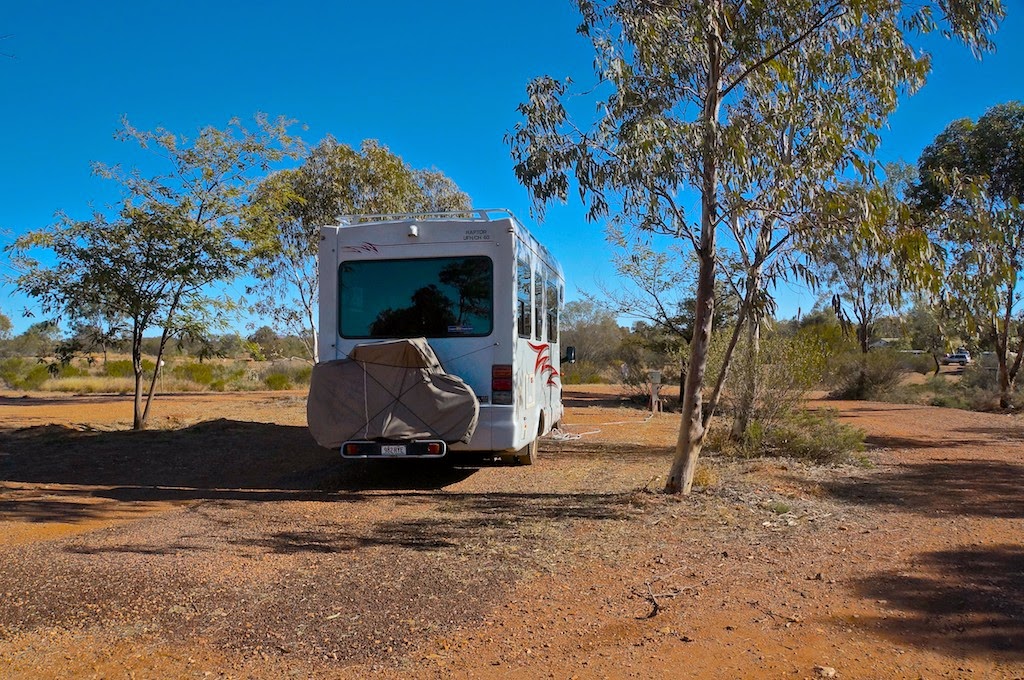
Our Bush Camp at Gemtree

First shooting of the shy Territory dingoes

Three wise men (or women) at the Devils Marbles

A lucky shot at the Marbles

Territory single lane roads - even used by road trains but not while we were using them

The Marbles are pretty big

A quirky shot from Sally

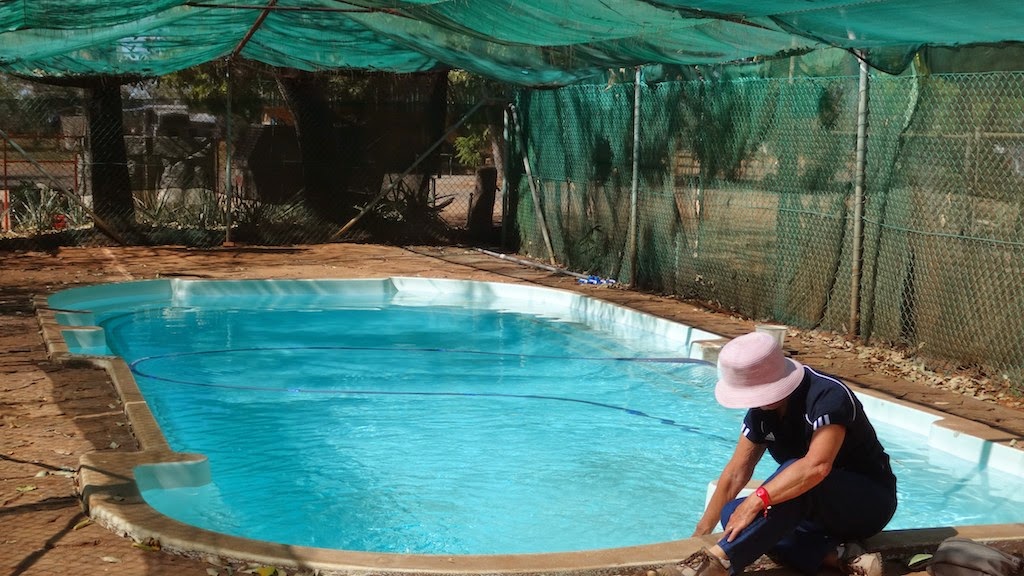
We are so far north that swimming is possible - maybe later this afternoon
So - here's a change. Sally is quilting so you get me doing the blog.  In return I have used some of Sally's photos to show that she is a better photographer than me.

The last post saw us leaving Alice Springs and contemplating going out of coverage for a week or so.  Thankfully we have had coverage in spots and are now in Tennant Creek.

As an addendum to the Alice post, I have added pictures of the quilt that hangs at the RFDS museum. It was judged Australia's best in 2008 and well deserved too.  Such precision and beauty that even a troglodyte like me was impressed.  Sally had a fantastic time for the last few days in Alice as we were parked next to Elaine and Brian.  Elaine is a long time quilter and so it left Brian and me with a lot of time while they talked quilts and crafts.  You meet some wonderful people on the way.  I discovered a leak in our main water tank 24 hours before leaving Alice and with Brian's help and transport managed to remove the tank and have it repaired before reinstalling and all over a period of about 3 hours.

On our last day in Alice we went for coffee at our favourite "Red Dog Cafe" which just happened to be owned by Brian's cousin (he discovered that while in Alice).  They are lovely people and serve great coffee.  We sat next to a pair of grandparents with their 5 year old grand daughter.  What a card - she talked non stop and the crowning line was "MY hair smells of Bug Killer".  Grandmother laughed and admitted that the nits in Alice are so bad that the only treatment that works is "Frontline" - yes the stuff they use on dogs for fleas.  I had pictured this beautiful girl with a dog collar for a necklace but apparently you can buy it in liquid form.  We have had the most wonderful conversations over morning tea in all sorts of places.

Reluctantly we left Alice, a town we had grown to love, and headed North on the Stuart and then turned onto the Plenty Highway driving 70 km to the Gemtree Campground.  The attraction was the legendary Campfire roast held on Wednesday nights.  We were not disappointed - a huge meal with seconds and the most tender beef I have eaten - and that's saying something given that we get our meat at home from Queensland's best butcher.  It must have been the atmosphere - the stars above, the two campfires and the old newsreel style movie of the proprietors' family history.  Dated from the time that the grandfather had set out from NSW with family and wagon arriving in Gemtree over a year later, some story.  Gemtree is named for the gem fossicking industry in the area but we resisted the urge to get down and dirty and left the next day headed west to rejoin the Stuart and the north towards Litchfield.  140 Km just for a baked dinner - distance matters little in the Centre.

The Stuart is a beautiful 2 lane highway with unrestricted speed so it is the first step down to get on to a one lane bitumen road which was what we had all the way to Gemtree.  The idea is that you drive in the middle of the bitumen until you have a two car situation and then you work it out.  Our strategy was one of total submission so when a car was spotted in front or in the mirror we pulled over and parked on the verge till they had gone.  The idea was to avoid dust and stones.  You would be amazed how many 4x4 people couldn't cope with this and took to the dirt just to spray us.  Luckily there was no damage from flying stones.  It is amazing how much damage these people cause to their own cars by doing 100k on rough dirt tracks.  The rear skirt on many had been peppered with, not chips, but divots from their own flying stones.  There is certainly a smell of testosterone in the air when you talk with them.  There is a picture above of one such encounter.

We stopped at a couple of Roadhouses and mixed with the many tourists and nomads plying this busy highway.  Aileron, which is the town of the Big Aborigine, Barrow Creek, Ti Tree and eventually we arrived at the highlight of the day - the Devils Marbles.  The marbles bit is obvious but why the devil I'm not sure (Sally would look it up and give you the history if she was writing this but I guess I'm lazier).

I have included some of our photos of the Marbles but it is hard to show the magnitude of the group.  The first amazing thing was to get a photo of a real live dingo up close.  We have seen almost no wildlife on the trip and it was almost like it had been trained to sit in the carpark and wait for tourists.  It is a bit like Stonehenge in the 60s when you could crawl all over the rocks so we joined the throng and the challenge was to get people-free photos.  We were there for about 30 minutes and moved out with a mission to reach Tennant Creek that night.

Many years ago Sally had a sewing machine called an Elna Lotus.  When she bought a lovely Bernina full size machine she handed it down to the kids and now she has been longing for the compact Lotus (which we bought in Nottingham in 1969).  Just out of Alice Springs Sal found a near new Lotus on Gumtree still in the box and protected by the foam inserts.  It was for sale in Tewantin and only used by a little old lady who was now in a Nursing Home.  With very patchy 3G coverage we negotiated the deal and finalised it as we arrived in Tennant Creek.  It's funny the things you find to do while driving hundreds of kilometres on an unrestricted highway.  Deal done and safely at Tennant Creek in a beautiful, fairly dusty, old but clean camp ground.  They have Imparga TV coverage so at 9 tonight I can gnash my teeth watching a game that Manly needs to win to avoid the possibility of going from first to fifth on the ladder. Go the mighty Maroon and Whites - see there is a time each week when I barrack for the real original Maroons.

Tennant Creek is a real surprise - quite a nice little town with a couple of pubs and a hospital, post office, supermarket etc.  We found the most wonderful little Greek Cafe for lunch and will be back for Brunch before we leave tomorrow morning.  Our next stop is Daly Waters where the pub does great meals we are told (who says life doesn't revolve around food?).

Once again I must warn you that coverage will be limited but we are really looking forward to a holiday in Litchfield and Kakadu.  Hopefully Chris and Brittney will have sprogged soon with our second Great Grandchild so that we can rip the top off the champers that we are saving for the occasion.  Keep smiling guys and get plenty of rest, you will need to bank some sleep for  the night shifts ahead.  We wish we could be there but no doubt when we arrive in August there will still be some baby hugs left.
For now that's all folks and normal transmission will resume after Litchfield.

PS

Sorry I left out some of the wide shots of the Marbles.  Look at the size of the people in the third one.  After the last picture Sally has added some real information.  You can't keep a good raconteur down.


Yep, I can't help myself.  We did wonder why Devil's Marbles? and here is what I found.  John Ross, of the Australian Overland Telegraph Line expedition, 1870, said :
"This is the Devil's country; he's even emptied his bag of marbles around the place".

More interestingly, the Aboriginal term is Karlu Karlu, which translates as Round Boulders.  One of the main Dreaming stories for the area relates to how Karlu Karlu was made.  This tradition tells of Arrange, the Devil Man, who came from a hill nearby and travelled through the area.  Whilst walking along, Arrange made a hair-string belt.  As he was twirling the hair to make strips, he dropped clusters of hair on the ground.  The clusters turned into the big red boulders at Karlu Karlu that have become so famous today.  On his way back to his hill, Arrange spat on the ground.  His spit turned into the granite boulders in the central part of the reserve.  Arrange finally returned to his place of origin, a hill called Ayleparrarntenhe, where he remains today.

Just saying!